

Thematic Investing as a Central Part of Today’s Investment Portfolios
8 mins to read this article

Introduction
For a long time, investing followed a neat path: choose a region, an industry, or an investment style, and build from there. These labels are useful, but they are old filing cabinets. They place companies in tidy drawers: technology, industrials, consumer, health care. Yet the world no longer changes drawer by drawer. AI needs chips, power, cooling, cloud, cyber security and metals. A filing cabinet splits that story apart.
Thematic investing breaks from that logic. It helps investors choose a direction.




From a niche idea to a portfolio tool
Thematic investing began as a set of bold but narrow ideas. Water, clean energy and ageing were among the first to gain wide use. Most investors saw them as add-ons, sitting at the edge of the portfolio rather than at its centre.
That view now looks too narrow. Morningstar estimates that global thematic fund assets reached USD 779 billion by the end of the third quarter of 2025, counting over 3,000 thematic funds. Europe still holds the largest share, with almost half of global assets, but its lead has shrunk as the US and the rest of the world have grown faster. Yet thematic investing globally remains a small corner of the investment world. It represents roughly 2.5% of the total equity funds assets.
Europe largest thematic investor (USD billions)
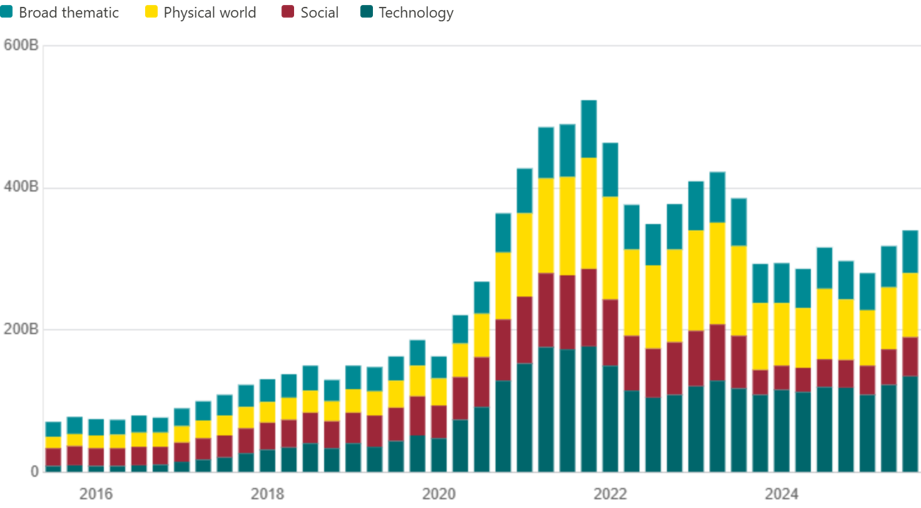
Source: Morningstar, Global Thematic Fund Landscape 2025
The instrument has changed too. Thematic investing once meant mainly active mutual funds, where managers choose the investments. It now includes ETFs, which are low-cost funds traded like shares. In Europe, thematic ETFs held a quarter of the thematic market by March 2026, making themes easier to buy, combine and explain.
Still, scale does not make every theme interesting. Some funds ride hype or sell a name more than a real link to the theme. The aim is to invest in long-term structural changes, not chase every label.
Comparison with traditional investing
Traditional investing maps where companies sit today. Thematic investing follows the chain of change and where future profits may emerge.
For any investor, the ultimate and dreamt goal is to identify the next market leaders. But they rarely fit old boxes at the start. They grow where new demand, tools and habits meet. WisdomTree’s research shows how the world’s largest companies change from decade to decade, with few firms staying at the top for long. A theme is therefore not just a label; it shows where future profits may be made.
Thematic investing is all about future trends and champions
World’s 10 largest companies by market capitalization, at the start of each decade
| 1980 | 1990 | 2000 | 2010 | 2020 | 2030 | |
| 1 | IBM | Nippon T&T | Microsoft | Exxon Mobil | Microsoft | ? |
| 2 | AT&T | Bank of Tokyo Mitsubishi | General Electric | PetroChina | Apple | |
| 3 | Exxon | Industrial Bank of Japan | NTT DoCoMo | Apple | Amazon | |
| 4 | Standard oil | Sumitomo Mitsui Banking | Cisco Systems | BHP Billiton | ||
| 5 | Schlumberger | Toyota | Walmart | Microsoft | ||
| 6 | Shell | Fuji Bank | Intel | ICBC | Alibaba | |
| 7 | Mobil | Dai-Ichi Kangyo Bank | NTT | Petrobras | Tencent | |
| 8 | Atlantic Richfield | IBM | Exxon Mobil | China Construction Bank | Johnson & Johnson | |
| 9 | General Electric | UFJ Bank | Lucent Technologies | Royal Dutch Shell | JP Morgan Chase | |
| 10 | Kodak | Exxon | Deutsche Telekom | Nestlé | Exxon Mobil |
Source: Firstlinks, History isn’t on the side of the Magnificent Seven, 2024
Key benefits of thematic investing
The first strength is clarity. “A global fund focused on fast-growing companies” can still feel abstract. Cyber security, clean power, ageing or robotics feel tangible and manifest. Themes link capital to the world investors can see.
The second strength is the variety. A good theme does not stop at the most obvious stock. Clean power, for example, is not only wind and solar, but smart grids, battery storage, copper, charging infrastructure and AI.
The third strength is flexibility. Themes can adapt as the world changes. Defence and security gained force as geopolitics grew tense. Nuclear drew fresh interest as AI raised power needs. AI itself has moved from software into chips, energy, robots and workflows.
But themes also bring risk. They can overlap. They can crowd into the same large stocks. They can charge high fees. Morningstar (Global Thematic Fund Landscape 2025) warns that, over long periods, few thematic funds both survive and beat global equities. This does not kill the case. It sharpens it. Investors need discipline, rigorous research and process, not labels.
The case of autonomous driving
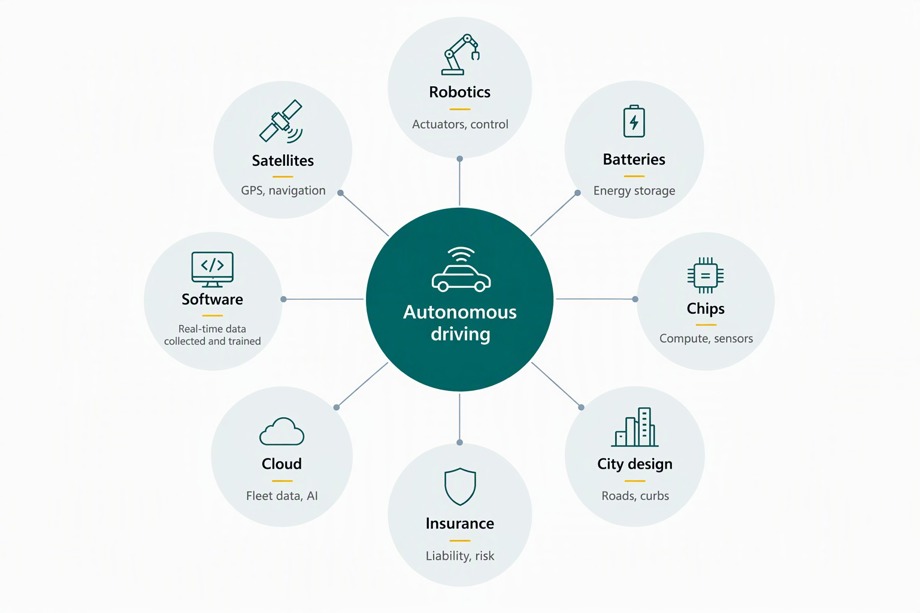
Autonomous driving shows why the thematic lens works. It is not simply “cars will drive without a human driver”. It is a web: chips, batteries, robotics, maps, satellites, cloud, insurance and city design. The deeper idea is that mobility may become more digital, automated and service-led. A sector fund may miss this web.
A theme can map it all:
Thematic investing as a core allocation
For years, investors treated themes like seasoning: a small addition to make a portfolio tastier. That view is now too modest. Some themes shape the main drivers of growth itself.
A core stock portfolio should not only mirror the past. Large market benchmarks, such as global stock indexes, often own yesterday’s winners in large size. This can work for long periods, but it may also leave investors late to where future profits may be made. Themes give a portfolio a stronger bias towards future growth areas.
This does not mean putting the whole stock portfolio into themes or buying the latest hot fund. It means giving themes a dedicated place: large enough to matter, broad enough to last and disciplined enough to avoid short-lived fads. Investors should own several themes, check whether prices look reasonable, avoid too much overlap, and adjust the mix as cycles shift.
Breadth of the thematic opportunity set
Thematic investing is not limited to a few ideas. To us, it covers five broad megaforces: demographic and social change; regulation and policy; sustainability; technology; and geopolitical fragmentation.
These forces help test whether a future view can become a reason or not to invest. Autonomous driving is shaped by several forces. Urban demand may support smarter mobility systems, technology is essential to adoption, and geopolitics can increase risk by limiting access to key materials and components. The goal is not to guess the future, but to ask what could push a theme forward, what could slow it down, and where value may be created.
How to get started
The best way to start is to look at daily life. What is changing around us? More digital services, more focus on health, new energy systems and new security needs are all clues.
Investors should then choose a set of diversified themes. Funds and ETFs, can give access to many firms within a theme. But a thematic label does not guarantee substance. Investors need to open the box and check what’s in it.
Finally, they should think in years, not months. Themes develop over long periods. Short-term swings are normal. The key is to track the trend, which could extend over various economic cycles, not every market moves.
Conclusion
The world does not change by sector code. It changes through new tools, needs, risks and habits. AI changes power demand. Ageing changes health care. War changes defence budgets. Scarcity changes the worth of metals and water.
Thematic gives investors a way to invest in that change. It does not remove risk or promise outperformance. But it asks the right question: not what the market looked like yesterday, but what the world may look like tomorrow.
That is why thematics deserve a place at the core: not as hype, but as a clear way to invest in the future as it takes shape.
What’s next
Thematic investing approach requires more than spotting a trend. We test each theme against economic, technological, political and social developments. We look for ideas that are broad enough to last, powerful enough to matter and diverse enough to provide access to many parts of the opportunity. The result is a range of carefully selected themes that aim to help investors participate in some of the most important transformations of our time.
Always there for you wherever you are
At Quintet, we pride ourselves on being small enough to really get to know you, yet big enough to give you easy access to the best the world of finance has to offer. Whatever your needs, we will provide objective insights, advice, products and services tailored to your personal goals. And with offices in 30+ cities across Europe and the UK we are always there for you wherever you are. Why not come and talk with us today?
Plain-English finance terms used in this paper: ETFs are low-cost funds traded like shares; value means cheaper shares; growth means faster-growing companies; a benchmark is a market yardstick used for comparison; valuation means whether prices look reasonable.
This document is designed as marketing material. This document has been composed by Quintet Private Bank (Europe) S.A., a public limited liability company (société anonyme) incorporated under the laws of the Grand Duchy of Luxembourg, registered with the Luxembourg trade and company register under number B 6.395 and having its registered office at 43, Boulevard Royal, L-2449 Luxembourg (“Quintet”). Quintet is supervised by the CSSF (Commission de Surveillance du Secteur Financier) and the ECB (European Central Bank).
This document is for information purposes only, does not constitute individual (investment) advice and investment decisions must not be based merely on this document.
Whenever this document mentions a product, service or advice, it should be considered only as an indication or summary and cannot be seen as complete or fully accurate. All (investment) decisions based on this information are at your own expense and at your own risk. It is up to you to (have) assess(ed) whether the product or service is suitable for your situation. Quintet and its employees cannot be held liable for any loss or damage arising out of the use of (any part of) this document. All copyrights and trademarks regarding this document are held by Quintet, unless expressly stated otherwise. You are not allowed to copy, duplicate in any form or redistribute or use in any way the contents of this document, completely or partially, without the prior explicit and written approval of Quintet. See the privacy notice on our website for how your personal data is used (https://www.quintet.com/en-gb/gdpr).
The contents of this document are based on publicly available information and/or sources which we deem trustworthy. Although reasonable care has been employed to publish data and information as truthfully and correctly as possible, we cannot accept any liability for the contents of this document.
Investing involves risks and the value of investments may go up or down. Past performance is no indication of future performance. Any projections and forecasts are based on a certain number of suppositions and assumptions concerning the current and future market conditions and there is no guarantee that the expected result will ultimately be achieved. Currency fluctuations may influence your returns.
The information included is subject to change and Quintet has no obligation after the date of publication of the text to update or inform the information accordingly.
Copyright © Quintet Private Bank (Europe) S.A. 2026. All rights reserved. Privacy Statement