

Clean Energy: don’t call it a comeback
10 mins to read this article





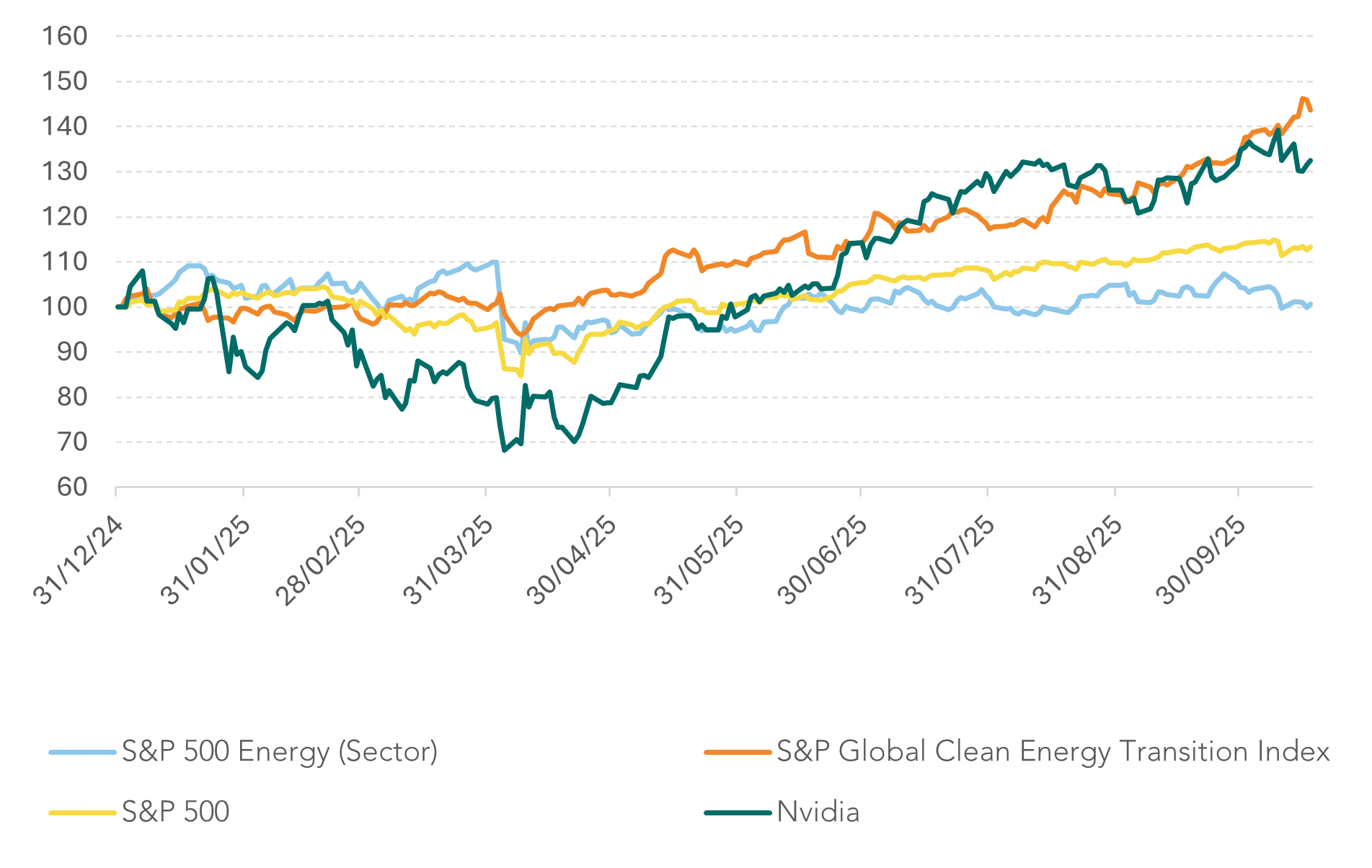
The start of 2025 drew concerns over how sustainability would fare given the Trump administrations opposition towards it. Despite this, clean energy has re-emerged as one of the strongest-performing segments of markets, driven by rising electing demand, accelerating electrification and the urgent need for reliable, low carbon power. Performance has not been driven by sentiment alone; it reflects a fundamental shift in how the world produces and consumes energy.
Growing Energy Demand
The key drivers behind the resurgence of clean energy lies behind the increase of demand in electricity stemming from increased use of AI and Datacentres, population growth and concerns over energy security.
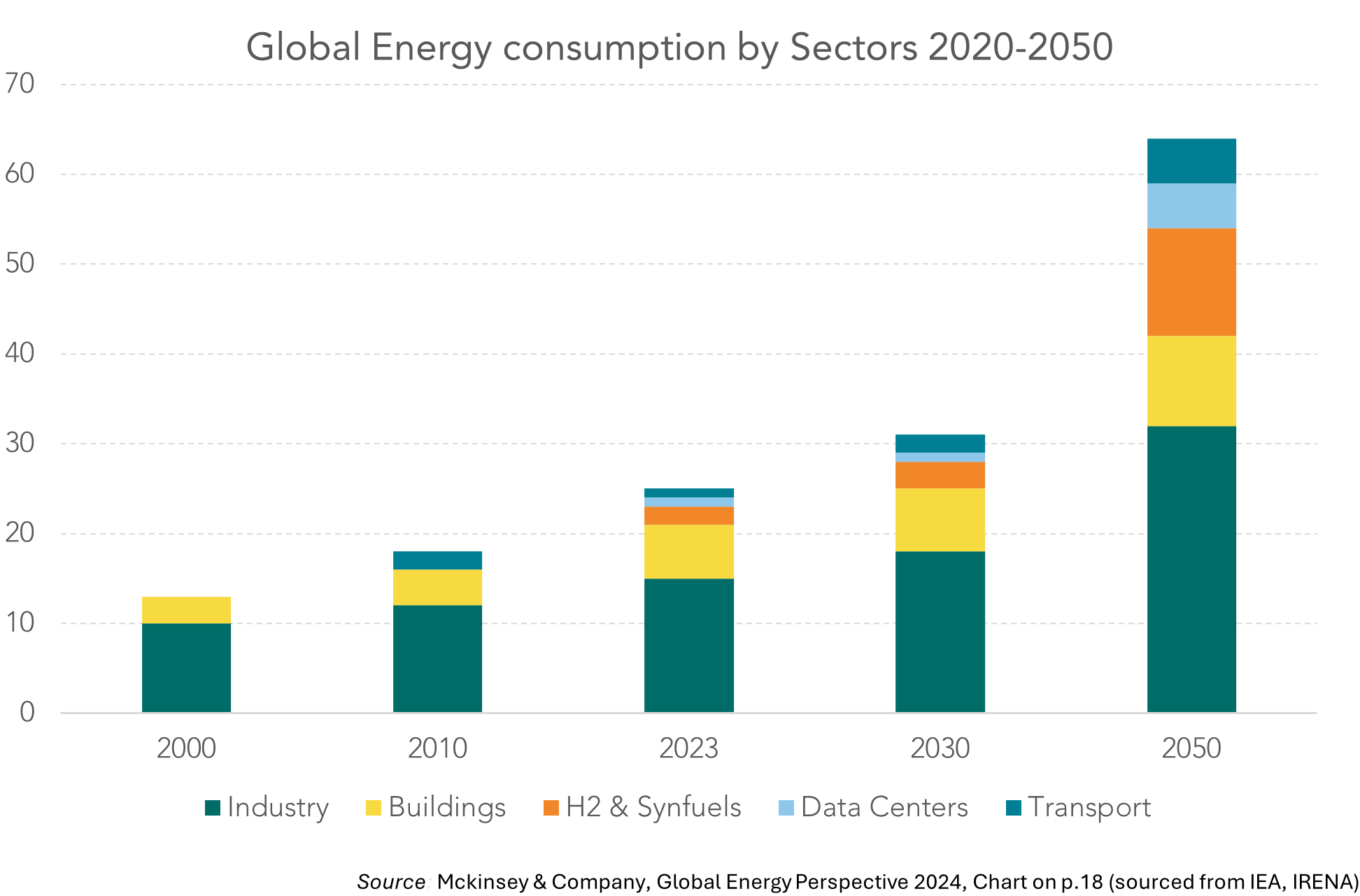
AI and Datacentres are emerging as a major incremental source of demand, with some hyperscaler data centres consuming the same amount of energy as small cities. It is currently estimated that AI and Hyperscalers account for 1.5% of global electricity consumption, and that by 2030 this will double to 3% and could reach 10% by 20501 . Whilst AI and datacentres make up a considerable portion of growing demand, the majority of growing demand is being driven by long duration trends of onshoring, electrification and population growth – with electricity power generation globally, and in the US, expected to double by 20502. This marks a shift from decades of relatively stable energy growth and is entering a new period of structural growth.
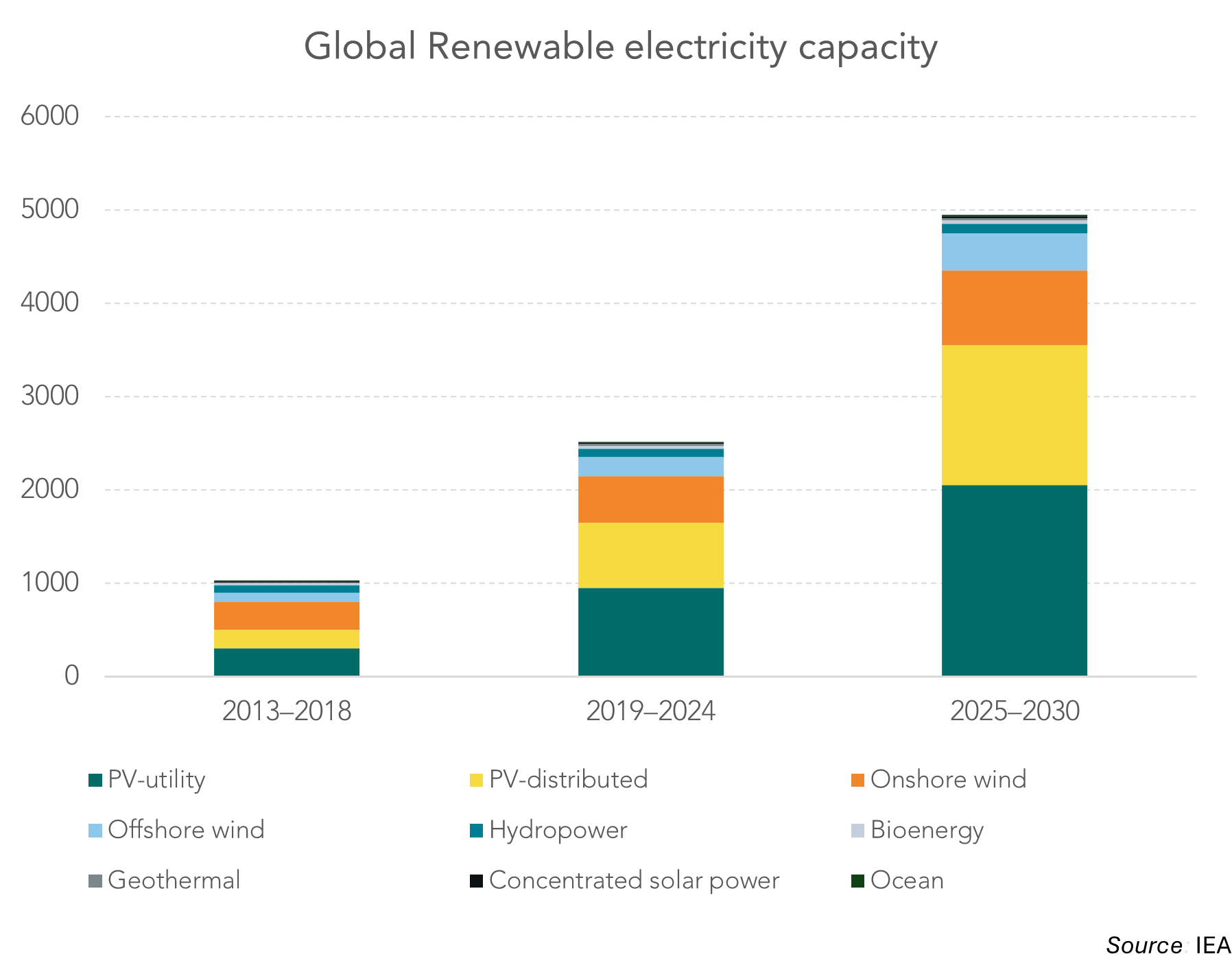
Renewable energy is no longer a niche transition theme, or one for the distant future, it is now central to meet critical energy demands. For the first time in history, capacity from renewable energy exceeded that of coal and will continue to grow, with expectations that by 2050 most of the global power generation will be from renewable energy.
Clean, Affordable and Fast
Clean energy is attractive in meeting growing electricity demand, especially in the near term, due to its scalability and rapid deployment. Clean energy technologies such as onshore wind and Utility scale solar do not have a green premium, meaning that it is less expensive than non-renewable alternatives. Whilst the wind doesn’t shine 24/7 and wind doesn’t blow on command, back-up power is usually used to compliment and guarantee round the clock energy supply, however even with such an additional cost it is still less expensive than non-renewable energy. Moreover, solar and wind farms offer rapid deployment, scalability and the option off-grid solutions.
AI, Hyperscalers & Clean energy
Datacentres, whether for AI or Hyperscalers, have formed a prominent relationship with clean energy. Whilst datacentres consume increasing amounts of power, companies such as Google, Meta, Microsoft and Amazon still have net-zero ambitions which they aim to adhere to – hence why all of the power consumed by their datacentres has come from renewable sources3.
Additionally, increases in power consumption from datacentres have led to concerns over local and regional grid systems, with the potential of causing energy shortages, impacting civilian populations and causing disruptions for datacentres. Subsequently, energy supply is a major risk for Hyperscalers, with companies (Alphabet, Meta, Amazon and Microsoft) making significant efforts to secure exclusive rights to energy, in the form of nuclear purchase agreements, or investing in onsite wind or solar. Currently, only 2% of datacentres consume electricity from onsite power generation, however by 2030 over a quarter of datacentres in the US will consume energy from on-site wind or solar farms – alleviating the pressures on local energy grids4.
[1] IEA
[2] IEA
[3] BNEF, “Power Hungry Data Centers Are Driving Green Energy Demand”, 2025.
[4] Bloomenergy, “2025 Data Centre Power Report”, 2025
This document is designed as marketing material. This document has been composed by Quintet Private Bank (Europe) S.A., a public limited liability company (société anonyme) incorporated under the laws of the Grand Duchy of Luxembourg, registered with the Luxembourg trade and company register under number B 6.395 and having its registered office at 43, Boulevard Royal, L-2449 Luxembourg (“Quintet”). Quintet is supervised by the CSSF (Commission de Surveillance du Secteur Financier) and the ECB (European Central Bank).
This document is for information purposes only, does not constitute individual (investment) advice and investment decisions must not be based merely on this document.
Whenever this document mentions a product, service or advice, it should be considered only as an indication or summary and cannot be seen as complete or fully accurate. All (investment) decisions based on this information are at your own expense and at your own risk. It is up to you to (have) assess(ed) whether the product or service is suitable for your situation. Quintet and its employees cannot be held liable for any loss or damage arising out of the use of (any part of) this document. All copyrights and trademarks regarding this document are held by Quintet, unless expressly stated otherwise. You are not allowed to copy, duplicate in any form or redistribute or use in any way the contents of this document, completely or partially, without the prior explicit and written approval of Quintet. See the privacy notice on our website for how your personal data is used (https://www.quintet.com/en-gb/gdpr).
The contents of this document are based on publicly available information and/or sources which we deem trustworthy. Although reasonable care has been employed to publish data and information as truthfully and correctly as possible, we cannot accept any liability for the contents of this document.
Investing involves risks and the value of investments may go up or down. Past performance is no indication of future performance. Any projections and forecasts are based on a certain number of suppositions and assumptions concerning the current and future market conditions and there is no guarantee that the expected result will ultimately be achieved. Currency fluctuations may influence your returns.
The information included is subject to change and Quintet has no obligation after the date of publication of the text to update or inform the information accordingly.
Copyright © Quintet Private Bank (Europe) S.A. 2025. All rights reserved. Privacy Statement