

Inflation is rising. Is growth still holding up?
5 mins to read this article


What matters to you in 30 seconds
-
Inflation is proving harder to tame: higher energy costs helped push US inflation to 3.7% in September, while producer prices rose at their fastest pace in four years.
-
The economy is holding up: the IMF has raised its 2026 global growth forecast to 3.1%, reinforcing our view that the global economy remains resilient.
-
AI is facing a reality check: AI-related shares came under pressure as investors questioned the financing and eventual returns from heavy infrastructure spending, although we remain positive about AI's long-term potential.
Chart of the weeK
Source: In-house research, Bloomberg




Growth remains resilient, but inflation remains in focus
The global economy continues to hold up better than many expected. Last week, the IMF raised its forecast for global growth in 2026 to 3.1%, largely reflecting stronger expectations for Europe and India. This supports our view that growth is on a solid footing and provides a supportive backdrop for company earnings. However, the political uncertainty Europe, highlighted by the riots in France over the weekend, do pose downside risks to the region. This is one reason why we recently reduced our fixed income bond exposure to Europe, where France is the largest constituent
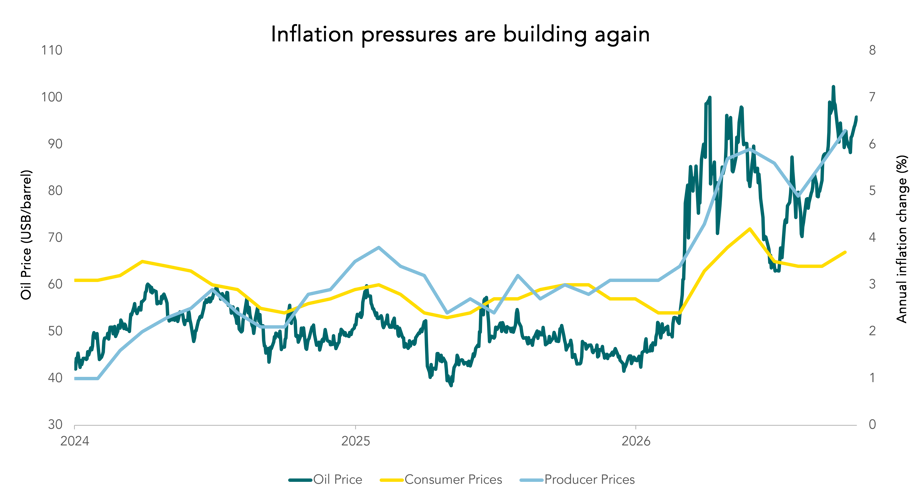
The more complicated part of the picture is inflation. The conflict in the Middle East has kept oil prices elevated, and that pressure is becoming visible in the US. Consumer inflation rose from 3.4% to 3.7% in September, with energy prices up 10.8%. Producer prices also rose 6.3% over the year, their strongest increase in four years.
As the chart shows, higher oil and production costs could feed through to consumer prices in the months ahead. That leaves investors with an unusual combination. Growth remains reasonably healthy, while inflation is proving more persistent. The longer that continues, the more likely interest rate increases become.
Central banks face some uncomfortable choices
Nowhere is that tension more apparent than in the US. Gasoline prices have remained above USD 4 per gallon for almost half a year, diesel prices have risen sharply, and the midterm elections are approaching. These higher energy costs are becoming more visible to households at a time when Donald Trump’s approval ratings have declined.
The US Federal Reserve's (Fed’s) next meeting comes just six days before the elections. Recent inflation data strengthen the argument for further rate hikes, although the Fed has historically been cautious about making major policy changes immediately before elections. Fed Chair Kevin Warsh has also emphasised that the broader inflation trend matters more than individual data releases. Markets therefore expect the Fed to hold rates in October’s meeting, but we believe we’ll likely see another increase in December.
We also expect the European Central Bank and Bank of England to raise rates before year-end. While the timing and circumstances may differ, there is a common thread: resilient growth is giving central banks greater scope to tackle inflation through higher rates.
AI enthusiasm meets a more demanding market
Higher borrowing costs also matter for one of the biggest investment themes of recent years. Shortly after the IMF warned about increasingly debt-financed AI infrastructure investment and rising global bond yields, AI-related equities came under pressure. Investors are paying closer attention to whether future revenues can justify the scale and financing of today's investment.
Technology shares fell across major markets, particularly in South Korea's KOSPI, which has substantial technology and semiconductor exposure, before recovering somewhat. US semiconductor stocks also declined. In contrast to Wall Street, European equity markets, with considerably less exposure to technology, edged higher.
We continue to believe that AI has substantial long-term potential. Recent volatility is a reminder, however, that high expectations leave less room for disappointment. Early third-quarter results from US banks and technology companies such as ASML have so far supported a broadly healthy earnings picture. The rest of earnings season will provide a more demanding test of whether profits can continue to support current valuations.
With market gains still concentrated among a relatively small group of companies, the largest technology businesses have little room to disappoint. Their results will help determine whether last week’s volatility was a temporary setback or the beginning of a broader reassessment.
This week
Can the data support the market's confidence?
Third-quarter earnings remain firmly in focus, with Meta, Procter & Gamble and Tesla among the major US companies due to report. Investors will be looking for evidence that profits can continue to support current market expectations despite higher financing costs.
There is also plenty happening beyond company results. Preliminary October purchasing managers' indices on Friday will provide a fresh reading on business activity on both sides of the Atlantic, while Eurozone consumer confidence is due the day before. UK inflation arrives on Wednesday and Japanese consumer prices on Friday.
Together, these releases should tell us more about the tension currently shaping markets: whether resilient economic growth can continue without bringing a sustained rise in inflation with it.