

France: why markets are growing uneasy
6 mins to read this article






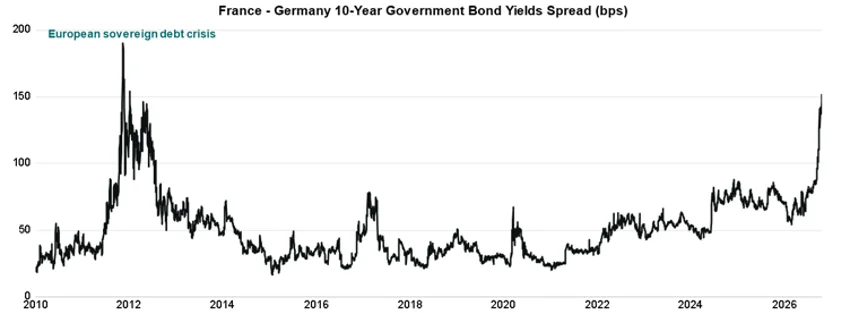
Since September, French markets have lagged their European peers. In equities, the CAC 40 (-5.6%) has underperformed the pan-European STOXX 600 (-1.7%). French 10-year government bond yields hit 5%, the highest level since 2002 and about 1.5% higher than their German counterparts. The euro has weakened 3% against the US dollar. These moves reflect the same concern: investors are becoming less comfortable with France’s fiscal and political outlook.
It’s about public finances…
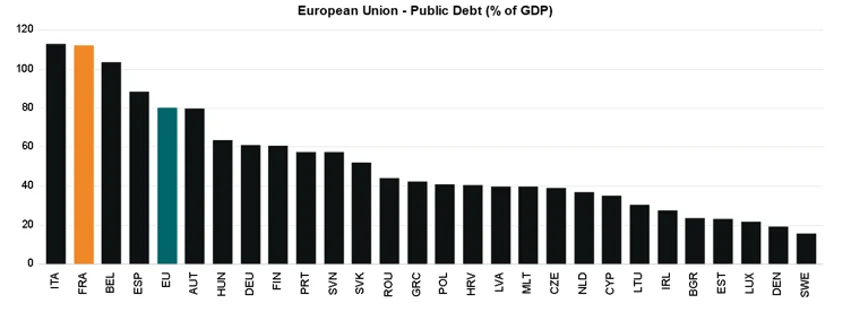
At the heart of those concerns lies the state of the country’s public finances. Government debt has reached 120% of GDP, one of the highest levels in the Eurozone. The budget deficit remains above 5% of GDP, well above European guidelines. At the same time, higher interest rates are making the problem harder to manage. Global government bond yields have risen in 2026, driven by higher energy prices and resilient economic growth, both resulting in expectations of higher interest rates. But French yields have risen the most, not helped by the deteriorating path of France’s public finances.
Source: In-house research, LSEG Datastream
For much of the past decade, governments could borrow at exceptionally low costs. Today, refinancing debt becomes materially more expensive. This makes it more difficult to stabilise public debt without difficult policy choices.
Investors are therefore focused on the budget process, which must be voted by the parliament by 17 December. The market’s reaction suggests investors are increasingly questioning France’s ability to reduce its deficit and stabilise its debt trajectory without making these difficult choices. The current draft budget may prevent a further deterioration in public finances and provide some relief but, on current projections, it is unlikely to fully stabilise the debt trajectory.
…and politics: what fiscal news could a change bring?
Fiscal concerns are only part of the story. Political uncertainty is also rising. Social tensions and protests driven by concerns around the cost of living potentially complicate the outlook for reform. Attention is shifting towards the presidential and legislative elections in 2027. Investors are trying to assess not only who might win, but also what a new government could mean for fiscal policy.
It is easy to assume that political change would lead to more spending and larger deficits, and there are several scenarios suggesting that this is a possible outcome. Yet the reality may be more nuanced. For instance, while most candidates have yet to unveil their economic proposals, proposals from the Rassemblement National, whose candidate currently leads most opinion polls, include spending restraint, a medium-term primary surplus and fiscal rules aimed at putting debt on a declining path. Whether those goals can credibly be achieved remains to be seen, but they challenge the view that a change in government would automatically mean fiscal expansion.
For now, markets remain unconvinced. Higher bond yields signal investor comfort with the debt path. Higher borrowing costs make fiscal promises harder to finance, raise the cost of inaction and reduce the range of policy options available to any future governments. In that sense, market pressure via higher bond yields can help push the political debate towards greater fiscal discipline.
Source: In-house research, LSEG Datastream. Past performance is not a reliable indicator of future returns
One thing is to be in opposition, another is to govern
Political incentives often change once parties move from opposition to government. Italy offers a useful example. Before Giorgia Meloni became Prime Minister in 2022, many investors feared a confrontation with European institutions and a deterioration in Italy’s fiscal position. Instead, the government adopted a much more pragmatic approach than many expected.
The reasons are straightforward. Governments must pass budgets, refinance debt and maintain investor confidence. High debt leaves less room for policy experimentation than campaign rhetoric may suggest. Financial markets and European institutions impose constraints that are difficult to ignore.
France may not necessarily follow the same path. Its politics and economy are different. Yet the broader lesson remains relevant: governing a country with debt close to 120% of GDP tends to encourage fiscal realism, regardless of political affiliation.
Not another euro crisis
Importantly, today’s Europe is much stronger than it was during the sovereign debt crisis of 2010-12. Banks are better capitalised, external imbalances are smaller, and the Eurozone’s institutional framework is more robust.
Europe now has safeguards that did not exist a decade ago. The European Stability Mechanism provides a financial backstop, while the European Central Bank has tools designed to prevent disorderly fragmentation in sovereign bond markets. These measures reduce the risk of stress in one country developing into a broader crisis.
France still needs a credible path to lower deficits and more stable debt. But today’s challenges should not automatically be viewed through the lens of the euro crisis. Europe is better prepared than it was ten or fifteen years ago.
For investors, the appropriate response is one of vigilance rather than alarm. We have reduced our exposure to European government bonds because political and fiscal uncertainty is unlikely to fade quickly. And, in portfolios where this is allowed by client knowledge and experience, along with regulations and investment guidelines, we recently added an instrument that appreciates when European equities fall. While this can’t eliminate the impact of hypothetical drawdowns, it can help mitigate it. We had previously reduced our exposure to European equities.
The French election still lies ahead and implementing any fiscal programme will be difficult. Markets are likely to challenge the credibility of whichever government emerges, unless a credible reform path is established. France faces a genuine fiscal adjustment that can no longer be delayed, and political uncertainty may continue to generate volatility. Yet this is not a repeat of the euro crisis. Europe has grown stronger, institutional safeguards are more robust and market pressure itself may encourage the fiscal discipline investors are looking for.