

A ‘Blue Tsunami’ changes the balance of power in Washington
6 mins to read this article


What matters to you in 30 seconds
-
Democrats have swept the US midterm elections, taking control of both the House of Representatives and the Senate.
-
With Congress and the White House now controlled by opposing parties, major changes to tax, spending and regulation will become harder to achieve. That could bring greater policy continuity, although tension over areas such as trade and AI is likely to remain.
-
The result does not alter our investment strategy. We remain slightly overweight equities and US Treasuries and expect the US dollar to trade broadly sideways.




Washington facing two years of gridlock
The final results of the US midterm elections are still being confirmed, but the political outcome is already clear. Democrats have won both the House of Representatives and the Senate, giving them control of Congress for the second half of President Trump’s term.
That leaves power divided in Washington. With Democrats controlling Congress and Republicans the White House, far-reaching legislative changes will become considerably more difficult.
For investors, that divided government could bring fewer policy changes. Neither side will be able to push through major legislation alone, reducing the likelihood of sweeping changes to taxation, spending or regulation. Compromise and stalemate could therefore define Washington in 2027 and 2028.
New US Congress composition following the Midterm Elections
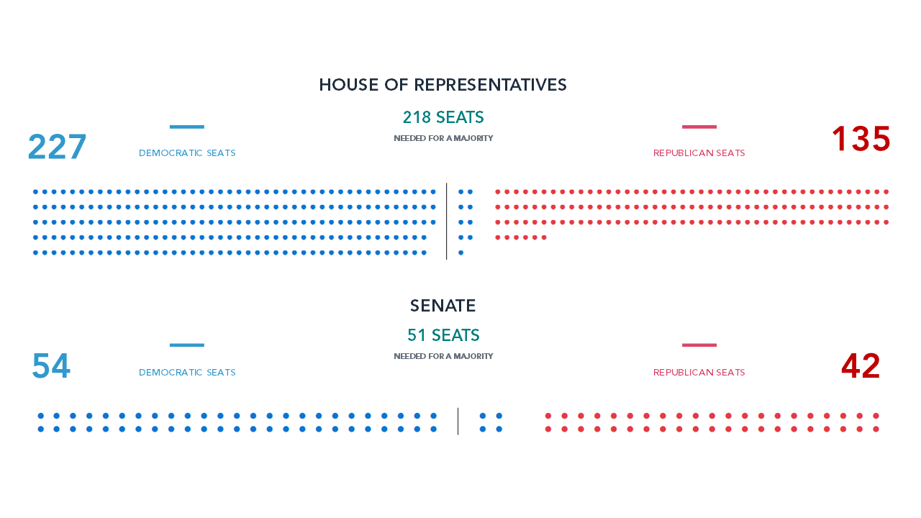
Source: In-house research, CNN (clearly allocated seats at the time of writing)
Control of both chambers gives Democrats considerably more influence over the second half of President Trump’s term. The Senate will have an important role in approving senior appointments, including judges and Federal Reserve (Fed) officials, while the House has authority over areas including spending, taxation, budgets and congressional oversight.
With major legislation harder to pass, President Trump may increasingly focus on areas where presidential authority is stronger. Trade policy, tariffs and foreign affairs could therefore become more prominent during the second half of his term.
Even so, we expect greater policy continuity rather than a major fiscal or regulatory shift. Some sectors could be more in focus, particularly areas favoured by the Trump Administration such as fossil fuels and artificial intelligence. Greater scrutiny of data-centre development in some states, for example, could add to regulatory concerns surrounding the AI investment cycle.
For the economy as a whole, however, our view has not changed. We do not expect the election result to materially alter our outlook for US growth through 2028. At this stage, we still believe that US economic and earnings growth is likely to stay solid.
A blue sweep does not remove political risk
Greater legislative constraint should not be mistaken for political calm.
The immediate aftermath of the election could remain unsettled if results are contested or lead to legal challenges, demonstrations or a broader political confrontation. Markets may also face periodic tension over budget negotiations, government shutdowns and the US debt ceiling.
Foreign policy is another area where Congress may have less influence over the direction of events. Developments involving Iran and Ukraine could continue to generate uncertainty, while further changes to US trade policy or tariffs remain possible.
These risks could produce bouts of market volatility. Once the immediate election uncertainty fades, however, divided government should lower the likelihood of sudden, far-reaching changes in domestic policy.
Attention is then likely to return to the forces with a more lasting influence on markets: inflation, Fed policy, economic growth, corporate earnings and the continuing investment cycle around AI.
The result supports our existing investment view
We see the election result as mildly negative for US equities in the very near term. Initial market reactions have reflected concerns about the reduced prospect of further fiscal expansion, alongside potential regulatory headwinds for AI.
Those concerns do not change our broader investment view over the medium term. Political gridlock has historically reduced the probability of substantial policy change and may give companies and investors a clearer basis on which to plan. We therefore maintain our slight overweight position in equities, with an emphasis on quality businesses and resilient earnings.
For US government bonds, the result looks mildly positive. Democratic control of Congress should reduce the likelihood of another large fiscal expansion and therefore some of the pressure for further increases in government debt. Inflation and monetary policy, however, will remain more important influences on bond yields. We continue to hold a slight overweight position in US Treasuries, providing income and diversification within portfolios.
The immediate impact on the US dollar also looks mildly negative, with the currency trading slightly weaker against the euro and sterling at the time of writing. We nevertheless retain our view that it will move broadly sideways over the coming months.
History provides some encouragement
Markets are unlikely to wait until the new Congress takes office on 3 January 2027 before reacting to the changed political landscape. And if history is any guide, the period following the midterms has often been a favorable one for US equities.
In our analysis of comparable periods since 1970, four of the six strong midterm years were followed by another positive year. The third year of the US presidential cycle, which will be 2027 in the current one, has also historically been the strongest year for the S&P 500. An even longer analysis of Wall Street’s trajectory following the weeks after midterms reveals a positive average performance into year-end.
Wall Street has typically gained through year-end following midterm elections
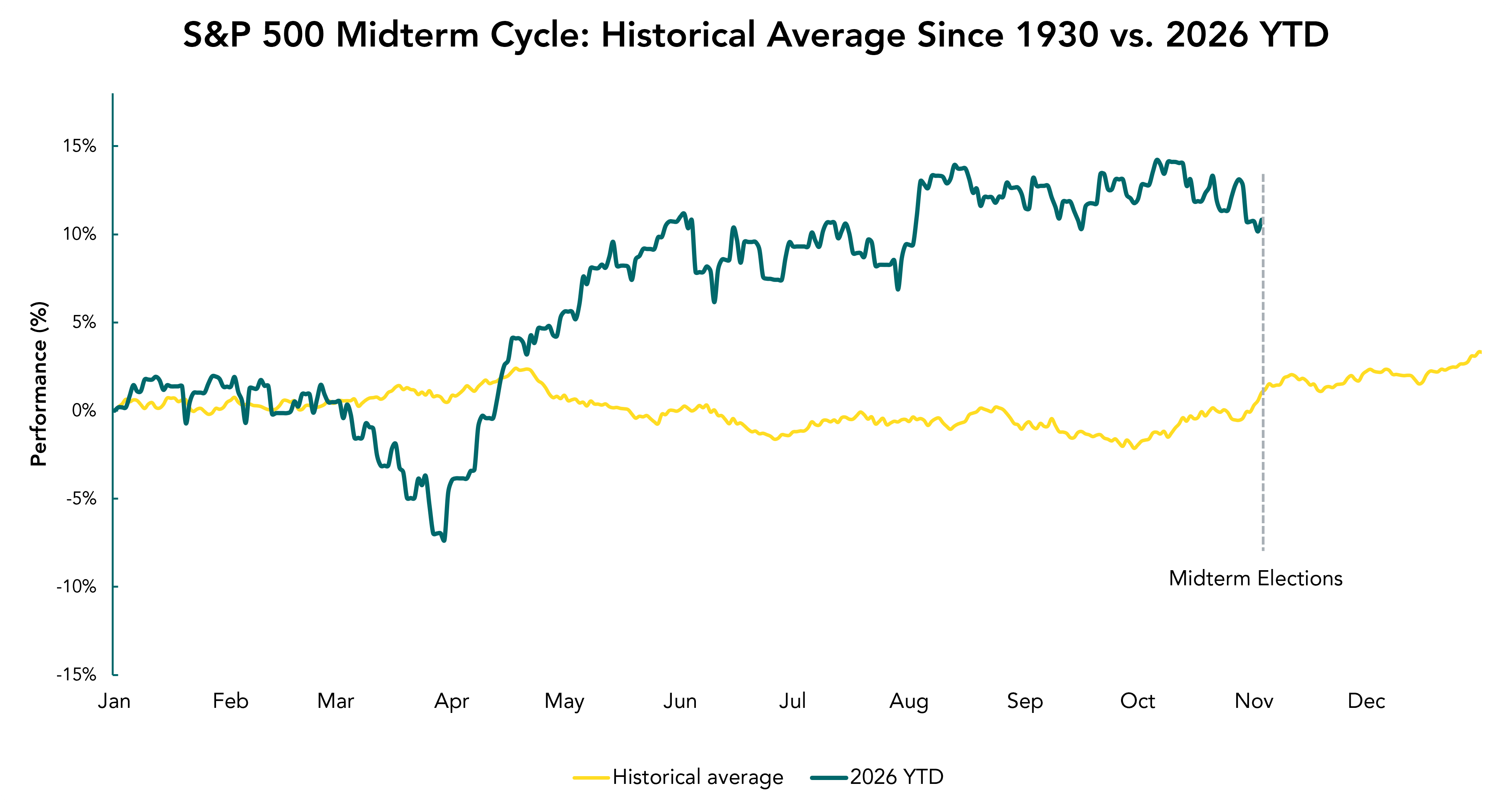
Source: In-house research, Bloomberg. Past performance is not a reliable indicator of future results.
History is a useful reference point rather than a forecast. Each election takes place against a different economic and geopolitical backdrop, and past performance cannot tell us what markets will do next. But it reinforces our broader view that the midterms themselves are unlikely to determine the investment outlook. Ultimately, we believe economic growth, inflation, interest rates and earnings will matter more than Washington.