







If you have looked at bond yields recently, you may have noticed something that has been missing for much of the past decade: income.
For years, investors became accustomed to a world where bonds offered little reward. Government bond yields hovered near zero or even in negative territory, central banks dominated markets, and generating a meaningful level of income often required taking significantly more risk. In that environment, bond investors depended heavily on falling yields and rising prices to achieve attractive returns.
Today, the landscape looks very different.
Bond yields have returned to levels that many investors have not seen in years, fundamentally changing the role fixed income can play within a portfolio. The most important development is not simply that yields are higher, it is that investors are once again being compensated for owning bonds.
Income is once again doing the heavy lifting
Historically, income was always intended to be the primary driver of bond returns. Investors lent money, collected coupons and received their capital back at maturity.
The era of ultra-low interest rates disrupted that relationship. With yields compressed by monetary policy, income became such a small portion of expected returns that investors increasingly relied on market movements to generate performance.
Today, starting yields are materially higher. As a result, a larger share of expected returns can once again come from the income generated by the bond itself rather than accurately predicting the direction of interest rates.
One of the most underappreciated consequences of higher starting yields is the cushion they provide against future rate increases. Over the past year, US Treasury investors generated positive total returns despite a meaningful rise in long-term yields. From current levels, 10-year Treasury yields would need to climb to roughly 6% over the next year, or around 6.9% over the next two years, before total returns turned negative. This illustrates how investors are no longer relying solely on falling yields to generate returns. The income earned along the way has become substantial enough to offset part of any potential price decline. It also reinforces the long-established relationship between starting yields and future bond return expectations.
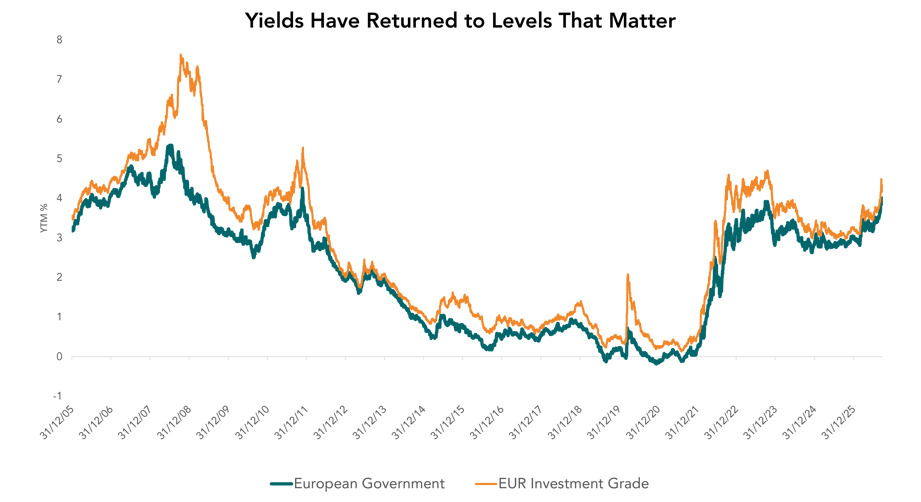
Yield to worst evolution | Sources: In-house research, Bloomberg
Bonds are behaving more like bonds again
The return of higher yields also means that fixed income is recovering another important characteristic: portfolio utility.
For many years, bonds were expensive by historical standards. Investors accepted significant interest-rate risk while receiving very limited compensation in return. In some cases, the balance between risk and potential return become less favourable. But now, conditions have changed.
Across large parts of the bond market, yields today more closely reflect underlying economic conditions, inflation expectations and credit risk. As a result, income levels are more consistent with the traditional role of fixed income within a diversified portfolio.
In other words, bonds are beginning to behave more like bonds again.
Investors no longer need to stretch for income
Perhaps the most significant consequence of this new environment is that investors can be more selective.
When yields were exceptionally low, generating income often meant taking additional risk through lower credit quality, longer maturities or more complex investment structures. Today, many higher-quality segments of the market already offer yields that would have been difficult to find only a few years ago.
This does not mean risk has disappeared. Interest rates, credit fundamentals, and economic conditions still matter. However, investors increasingly have the opportunity to pursue income without necessarily reaching for the highest-yielding assets available.
The focus shifts from maximising yield to maximising the quality and sustainability of that income.
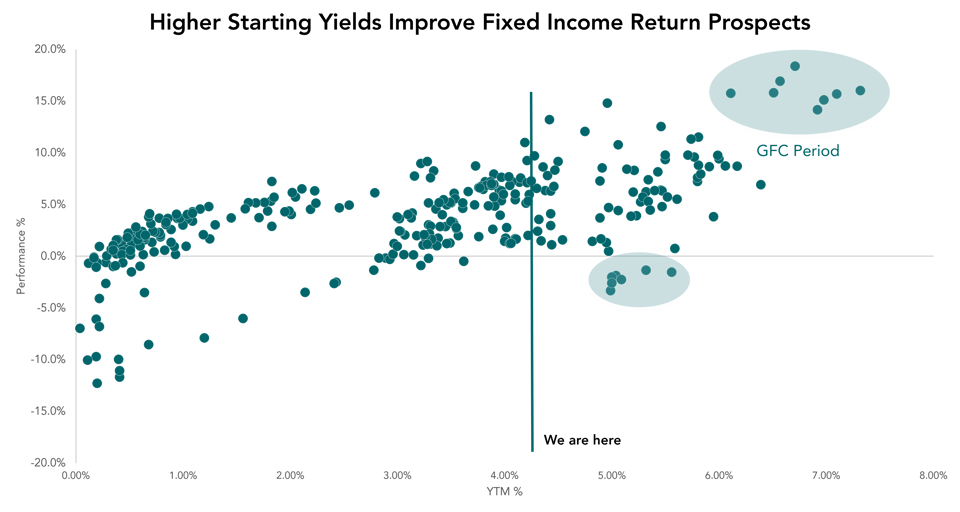
EUR Investment Grade Corporates 3 to 5 Yrs 12mth forward return calculated on a monthly basis | Sources: In-house research, Bloomberg
Income Is Back. Discipline Still Matters
The return of meaningful yields represents one of the most important changes in financial markets in recent years.
The significance of higher yields is not only the additional income they provide. Indeed, fixed income may once again provide a more balanced combination of income generation and diversification potential than it did during the period of ultra-low rates.
That said, the bond market has not become risk free. But for the first time in many years, investors are once again being compensated to take those risks.
And that may be the most important development of all.
Always there for you wherever you are
At Quintet, we pride ourselves on being small enough to really get to know you, yet big enough to give you easy access to the best the world of finance has to offer. Whatever your needs, we will provide objective insights, advice, products and services tailored to your personal goals. And with offices in 30+ cities across Europe and the UK we are always there for you wherever you are. Why not come and talk with us today?
This document is designed as marketing material. This document has been composed by Quintet Private Bank (Europe) S.A., a public limited liability company (société anonyme) incorporated under the laws of the Grand Duchy of Luxembourg, registered with the Luxembourg trade and company register under number B 6.395 and having its registered office at 43, Boulevard Royal, L-2449 Luxembourg (“Quintet”). Quintet is supervised by the CSSF (Commission de Surveillance du Secteur Financier) and the ECB (European Central Bank).
This document is for information purposes only, does not constitute individual (investment) advice and investment decisions must not be based merely on this document.
Whenever this document mentions a product, service or advice, it should be considered only as an indication or summary and cannot be seen as complete or fully accurate. All (investment) decisions based on this information are at your own expense and at your own risk. It is up to you to (have) assess(ed) whether the product or service is suitable for your situation. Quintet and its employees cannot be held liable for any loss or damage arising out of the use of (any part of) this document. All copyrights and trademarks regarding this document are held by Quintet, unless expressly stated otherwise. You are not allowed to copy, duplicate in any form or redistribute or use in any way the contents of this document, completely or partially, without the prior explicit and written approval of Quintet. See the privacy notice on our website for how your personal data is used (https://www.quintet.com/en-gb/gdpr).
The contents of this document are based on publicly available information and/or sources which we deem trustworthy. Although reasonable care has been employed to publish data and information as truthfully and correctly as possible, we cannot accept any liability for the contents of this document.
Investing involves risks and the value of investments may go up or down. Past performance is no indication of future performance. Any projections and forecasts are based on a certain number of suppositions and assumptions concerning the current and future market conditions and there is no guarantee that the expected result will ultimately be achieved. Currency fluctuations may influence your returns.
The information included is subject to change and Quintet has no obligation after the date of publication of the text to update or inform the information accordingly.
Copyright © Quintet Private Bank (Europe) S.A. 2026. All rights reserved. Privacy Statement